
Safety
RV Carbon Monoxide Detectors: Placement, Beeping Codes, and the Rules That Actually Matter
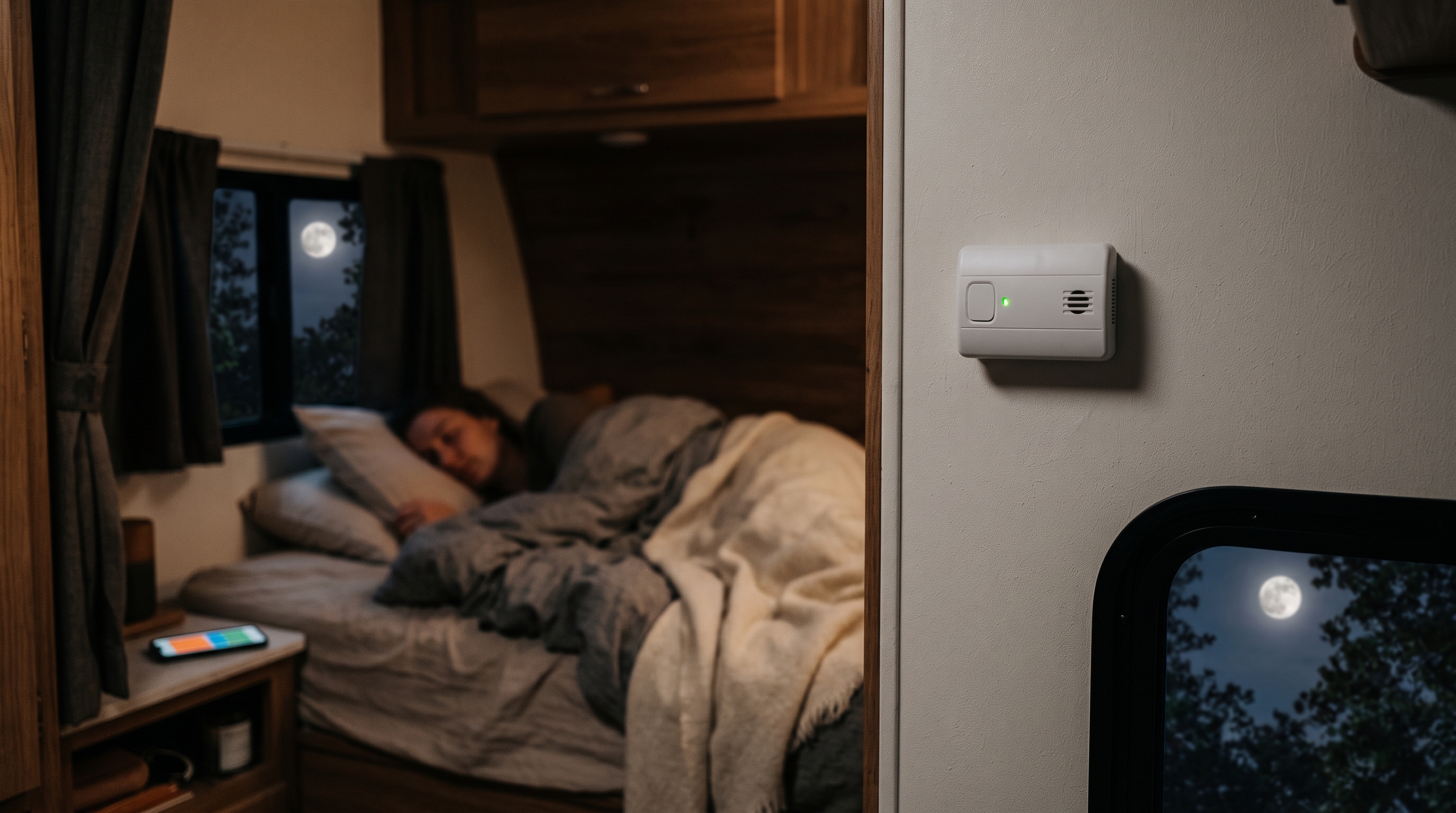
Carbon monoxide gives you no second chance. Propane has an odorant. Smoke you can see. CO is colorless, odorless, and produced by half the equipment in and around your rig — generator, furnace, water heater, stove, and the neighbor's generator twenty feet from your bedroom window.
The questions people actually search — where does it go, why is it beeping, when does it expire — get RV-specific answers below.
Why RVs are a special case for CO
An RV packs a propane furnace, water heater, stove/oven — often a propane fridge — and a generator into a few hundred square feet you sleep in; motorhomes add engine exhaust. At a campground, the nearest CO source is often not yours. Exhaust from the site next door can drift into your open windows or vent fan while you sleep.
What the standards actually require
NFPA 1192, the Standard on Recreational Vehicles, requires CO detection and is what RVIA-certified manufacturers build to. It points to UL 2034, which defines when a CO alarm must sound and what patterns it uses. In practice:
- Your RV came with a CO detector because the standard requires it — for every RV with an engine (or built to take one) and every truck camper, since at least the 2005 edition.
- RV detectors are usually 12V hardwired, running off your house battery — it matters below.
- UL 2034 alarms are time-weighted — they ignore brief, low-level CO but alarm fast at harmful concentrations. If it's alarming, it has already decided the exposure is dangerous.
What they don't promise: that it works forever. More below.
CO detector placement in an RV: where, and the height myth
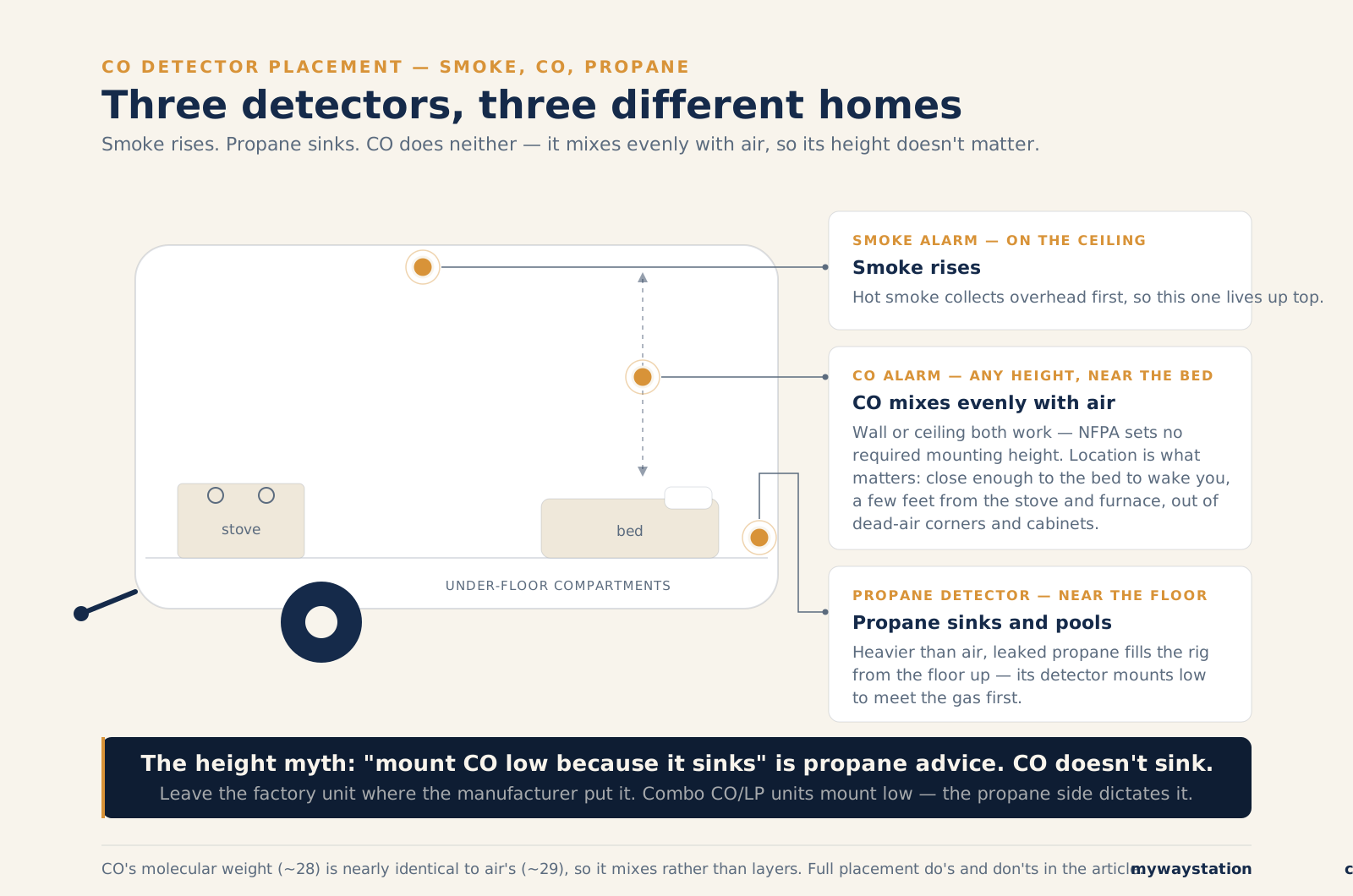
Three devices, three different homes: smoke rises, propane sinks, and CO mixes evenly with air — so CO placement is about location, not height.
The surprise: CO does not sink to the floor, and it doesn't reliably rise either. Its molecular weight (~28) nearly matches air's (~29), so it mixes evenly — which is why NFPA sets no required mounting height for CO alarms. The "mount it low" forum advice confuses CO with propane, which really is heavier than air — a different device, covered in our RV propane detector guide.
CO detector placement in an RV is about location, not height:
Do:
- Keep it near the sleeping area — CO kills people in their sleep, and the alarm has to wake you.
- Leave the factory detector where the manufacturer put it — that spot met the standard.
- Mount combo CO/propane units low, per their manual — the propane side requires it, and CO height doesn't matter.
- Add a second detector in a large rig or toy hauler. A closed bedroom door or a garage can put you out of earshot.
Don't:
- Not right next to the stove or furnace output — startup CO transients cause nuisance alerts.
- Not inside cabinets, behind curtains, or in dead-air corners — it samples the air it can reach.
- Not in front of a window, vent fan, or AC discharge — fresh airflow dilutes what it sees.
- Not on the floor because "CO sinks." It doesn't.
RV carbon monoxide detector beeping: the 6 reasons, decoded
The real alarm — CO detected
Get people and pets outside, shut down generator and propane, don't go back in until it stops. Symptoms (headache, dizziness, nausea, confusion)? Call 911.
End of life — the sensor has expired
Replacement is the only fix. Safe-T-Alert: red-red-green-green flash, snoozable 72 hours at a time for 30 days max. RVSafe: red double-flash, one chirp a minute, no reset.
Low house battery voltage
The RV-specific one: your detector is the canary for a sagging battery bank or failing converter — common in storage. Typically paired with an alternating red/green fault flash.
Low battery
Replace the battery. Still chirping? Check the replace-by date — battery and end-of-life chirps sound alike.
Malfunction or environment
Extreme heat or cold, humidity, or chemical vapors can trip fault modes. Check the manual's fault table; when in doubt, replace it.
Not a false alarm — exhaust is getting in
Exhaust leak, cracked heat exchanger, or drift through a window. This one earns an inspection, not a battery pull.
Three details the cards can't fit:
- When the four-beep alarm sounds, go — don't air the rig out "to check." It's UL 2034's pattern for real CO, and CO poisoning mimics the flu, minus the fever, worsening with re-exposure.
- The low-voltage chirp stumps everyone — "but it doesn't have a battery!" Your 12V detector chirps when the house battery sags, commonly in storage or with a failing converter. It's the canary for your battery bank — see our storage monitoring guide.
- "False" alarms usually have a cause. Owners in iRV2's "CO false alerts" thread trace theirs to battery hydrogen off-gassing on float charge, detector age, and low 12V; aerosol and pet-food triggers show up in propane-detector reports — our propane guide has that lineup. When in doubt, replace it: a $50–85 part (street price) protecting everyone in the rig.
The 5-year expiration nobody respects
CO sensors are electrochemical cells; they wear out no matter what. Residential alarms last 7–10 years; most RV-specific 12V detectors are rated for about 5 — and on common units the clock runs from installation, not manufacture (Safe-T-Alert keys it to the in-service date; RVSafe's clock only counts time powered). The replace-by date printed on the housing wins if it arrives first.
Go look at yours — a 30-second walk. Bought used? The detector is very likely past date, because almost nobody replaces them on schedule. An expired detector with a glowing power light is worse than none, because it looks like protection.
Replace like-for-like — a 12V RV-rated unit (or combo CO/LP) in the same spot — and write the install date on the housing in permanent marker.
Generator safety: the scenario that actually kills people
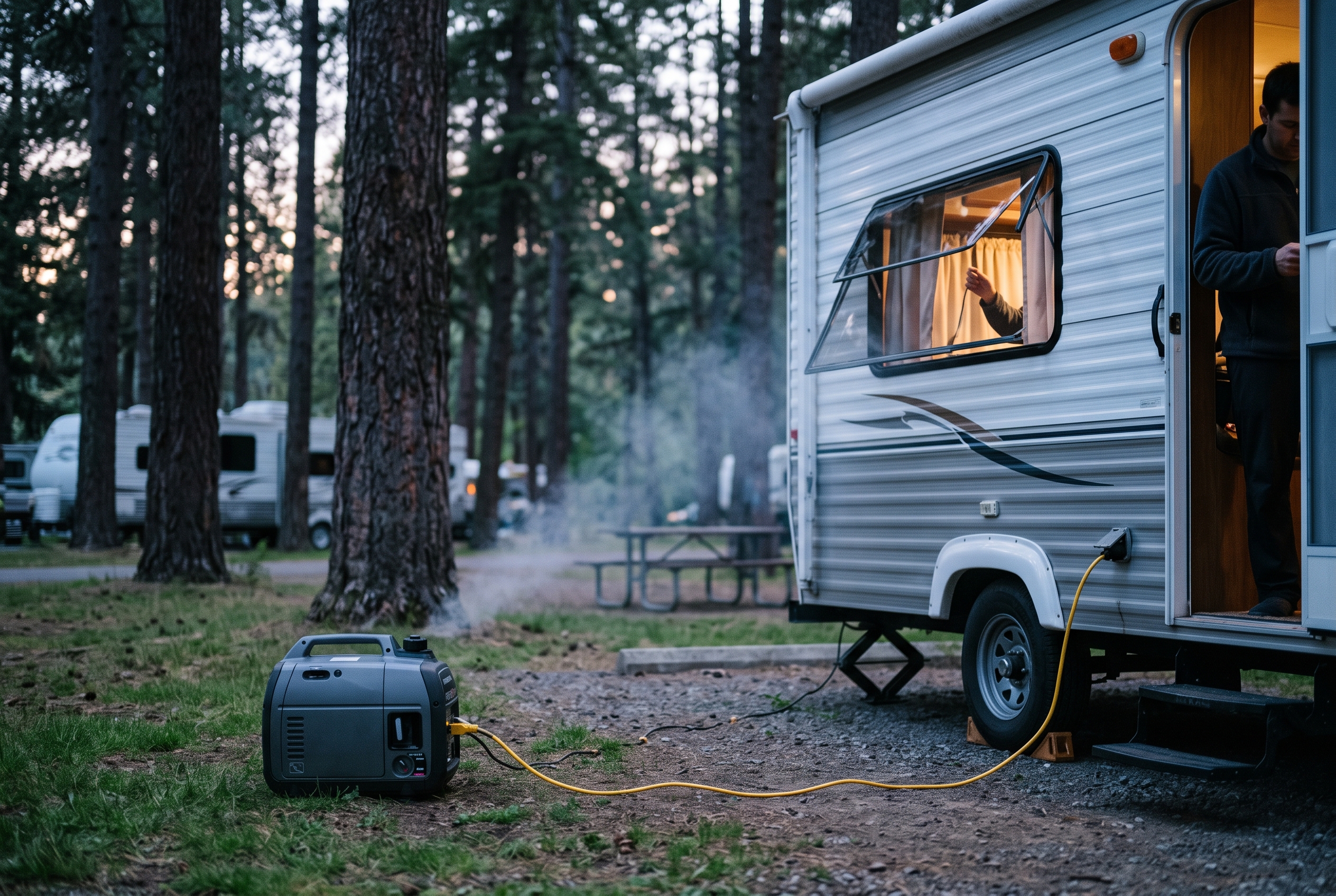
The U.S. Consumer Product Safety Commission attributes about 100 deaths per year to CO from portable generators — roughly 40% of all consumer-product CO deaths — and its reporting shows fatalities trending upward. The rules for RV generator carbon monoxide map onto how those deaths happen:
- Keep portable generators at least 20 feet away, exhaust pointed away (CPSC's number), and never near an open window, vent, or door — yours or anyone else's. Exhaust drifts farther at night; park with bedroom windows away from generator pads when you can.
- Never sleep with a portable generator running close by. Onboard RV generators exhaust away from the coach by design — the safer overnight option, assuming an intact exhaust system and a working detector.
- Never run any generator in an enclosed or semi-enclosed space — truck bed with a cap, under an awning against a wall, tucked under the rig. All have killed people, and a toy hauler garage can be lethal even with the ramp door open.
- Check your exhaust system every season. Rust, road damage, and rodents perforate routing you never look at. Detector alarms whenever the generator runs? Look here first.
Every propane appliance also makes CO when combustion goes wrong — a lazy yellow furnace flame, a sooty water heater burner, the stove used as a heater (never). The CO detector backstops every flame in the rig; our propane detector guide covers the appliances.
The gap a detector can't cover: asleep or away
A CO detector has one output: noise, right there, right then — which assumes someone is inside to hear it. Sleep is the first problem: CO exposure makes people harder to wake, so a loud, in-date detector near the bed is non-negotiable. No remote gadget replaces it.
The second: RVs spend most of their lives empty — in storage or at the campground — often with pets inside. A detector shrieking in an empty rig protects no one: you come back to a dog that's been listening to an alarm for six hours. Even the end-of-life or low-voltage chirp can start and finish between your visits.
That's the line between safety equipment and monitoring: the detector wakes you; a remote monitoring system reaches you when you're away — power loss, temperature climb, sometimes relayed alarm audio or CO readings. If a pet rides along, the gap is the whole ballgame — see our pet temperature safety guide and our comparison of RV monitoring systems. And a shopping note: standalone remote CO monitoring for RVs is still thin — most products handle temperature and power well, CO poorly or not at all. Nobody has solved that one yet.
The order is not negotiable: working in-date detector first, monitoring second.
FAQ
Where should a carbon monoxide detector be placed in an RV? Near the sleeping area, at any height — CO mixes evenly with air, and NFPA sets no required mounting height. Leave factory units where they are; combo CO/propane units mount low per their manual.
Why is my RV carbon monoxide detector beeping every 30 seconds? A beep every 25–60 seconds is usually end-of-life (check the replace-by date) or, on 12V units, low voltage — Safe-T-Alert manuals show alternating red/green with a beep every 15–30 seconds when house-battery voltage sags. Four quick beeps repeating is a real CO alarm: evacuate first.
How long do RV carbon monoxide detectors last? About 5 years for most 12V RV units, vs. 7–10 residential; the clock typically runs from installation, with the printed replace-by date as backstop. End-of-life snoozes are brief at best (Safe-T-Alert: 72-hour resets, 30 days max); then replace.
Do RVs come with carbon monoxide detectors? Yes — NFPA 1192 has required CO detection on engine-equipped (and engine-ready) RVs and truck campers since at least its 2005 edition. Bought used? Check it exists, is powered, and is in date.
Can I use a regular home CO detector in my RV? A battery-powered UL 2034 residential alarm beats nothing, but RV-rated 12V units handle temperature swings, vibration, and storage with no batteries to die. Replace a hardwired unit with a hardwired RV unit, not capped wires.
How far away should a generator be from an RV? At least 20 feet, exhaust pointed away, per CPSC — apply that to your neighbors' rigs too. Never under the rig, under an awning, in a truck cap, or in a toy hauler garage; never sleep with one running close by.
Bottom line
Three actions: check the replace-by date on your detector today; learn the four-beep alarm vs. the once-a-minute chirp; treat every generator — including the neighbor's — as if it's pointed at your bedroom window. The detector is cheap, the standard made most decisions for you, and the failure mode isn't a bad product review — it's the one alarm nobody heard.
Stay in the loop
Occasional updates from the road and the workbench — what we're learning, what we're building. No spam, easy out.