Pet safety
Leaving Your Dog in the RV: The Honest Guide to Doing It Safely
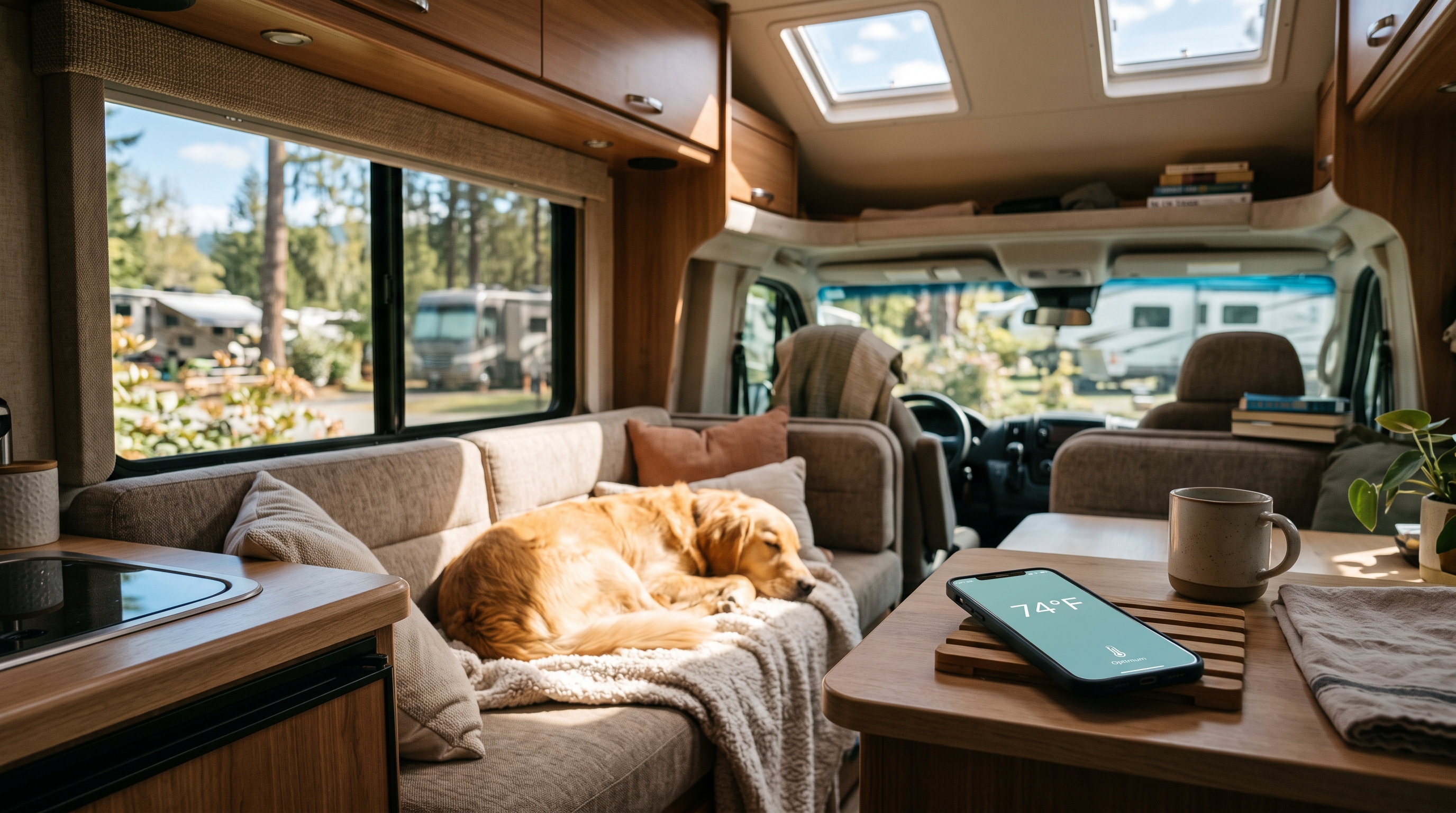
If you RV with a dog, you'll leave them alone in the rig sometimes — grocery runs, restaurants, no-pets trails. The usual "never leave your pet unattended" advice assumes a house and a dog-sitter; your rig is the house. The lecture is predictable enough that one owner asked r/RVLiving for monitor picks with a preemptive "Please don't tell me to just not leave them" — the plea is in the thread.
So, no lecture. The core idea: the danger is rarely a bad decision at noon. It's the situation changing at 12:40 with nothing to tell you.
How hot does an RV get in the sun?
The honest answer: nobody has measured RVs rigorously — the published studies are all about cars, and an RV is not a car. It's bigger, better insulated, and heats more slowly. But the car data is the best guide available, and it's worth knowing. The best dataset, from meteorologist Jan Null (San José State University), published in Pediatrics in 2005, shows the same curve at any outside temperature:
- 10 minutes: interior is ~19°F above outside
- 20 minutes: ~29°F above
- 30 minutes: ~34°F above
- 60 minutes: ~43°F above
The American Veterinary Medical Association cites the same figures. In a car, a 70°F day means over 110°F inside within the hour — with most of the rise in the first 30 minutes. An RV won't match that pace, but it's headed the same direction.
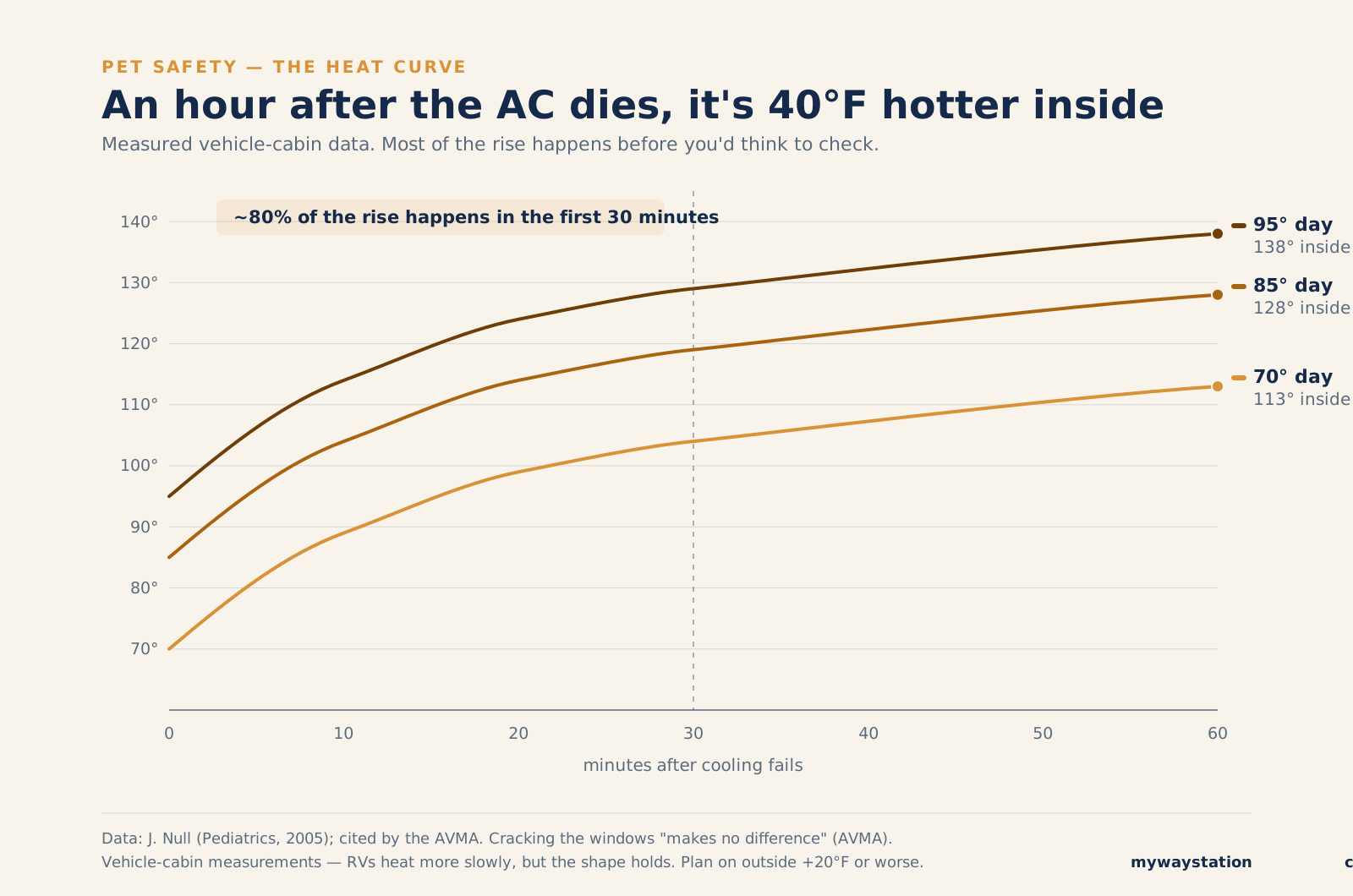
Measured closed-vehicle heating data from Jan Null (Pediatrics, 2005), as cited by the AVMA.
So where does that leave an RV? Slower than a car, but not safe: big windows, thin walls, and a sun-baked roof still do their work. Experienced RVers plan on outside-plus-20°F or worse within an hour of the AC stopping.
Cracked windows don't save you. The AVMA is blunt — "cracking the windows makes no difference" — and the Pediatrics study measured it: windows opened 1.5 inches changed nothing. Shade helps but doesn't fix it — and it moves while you're away.
The dog's side is worse. Normal body temperature is 100.5–102.5°F (VCA Animal Hospitals, Cornell); heatstroke starts around 105–106°F. Panting stops working much past 80°F ambient — PetMD's vet-reviewed guidance limits dogs to bathroom breaks at 80–90°F. A 95°F rig for two hours can be enough, especially for seniors, overweight dogs, thick coats, and flat-faced breeds.
The failure chain: how a safe rig becomes a dangerous one
Power drops at the pedestal
A campground breaker trips, a neighbor's rig overloads a shared circuit, the park browns out during peak AC hours. Pedestal power is the least reliable link in the system — and summer afternoons are precisely when it fails.
Your own equipment masks it
If you have an inverter, it does its job perfectly: lights stay on, fridge keeps running. But almost no inverter setup can run a rooftop air conditioner for long, if at all — so the one load that matters dies.
The AC just… stops
No alarm, no error. A rooftop unit that loses power goes quiet in a rig with nobody in it. Low-voltage brownouts can also trip the AC's protection or damage the compressor while everything else keeps working.
Heat builds silently
From here, the Null curve takes over. Ten minutes, twenty degrees closer to danger. Your dog notices first — and has no way to tell you.
Nothing in that chain is your mistake. The biggest upgrade isn't a better thermometer — it's a shore power loss alert that catches step 1.
The layered defense: five things, in order of importance
No single device makes this safe. Five layers do.
Layer 1: A temperature monitor with remote alerts
A sensor that pushes a phone alert when the interior crosses your threshold — over cellular, not campground WiFi, which fails exactly when campground power does. Pets "can literally bake in a very short period of time" if WiFi or power drops, as u/boiseshan warned on r/RVLiving. A MarCELL owner's "Life Saver" review (★★★★★, May 2026) credits an alert with saving her Yorkie. Our best RV monitoring systems comparison ranks Waggle, MarCELL, Temp Stick, and the rest by how they fail. Non-negotiable: battery backup, or it goes dark at the exact moment it exists for.
Layer 2: Power-loss alerting — the alarm that fires before the heat
The failure chain starts with power, so a power-loss alert beats a temperature-only alert: your warning moves from "the rig is 95°F" back to "the AC died 90 seconds ago." Some monitors do both; EMS devices and smart plugs work too (shore power loss alert guide). Run both: power for speed, temperature as the backstop.
Layer 3: A designated nearby human
An alert on your phone 200 miles away is news you can't act on. Know who can open that door within 20 minutes: a companion, a neighbor you've swapped numbers with, or the campground office with permission to enter. Leave a key or keypad code.
Layer 4: Make the AC less likely to die in the first place
Rooftop ACs die most often on the hottest day, at max load, on marginal voltage. Clean filters and coils each season; consider a soft-start device (Micro-Air's EasyStart line — the current RV model is the EasyStart Breeze) to cut startup surge, and an EMS-style surge protector to block the low-voltage sags that cook compressors.
Layer 5: The basics — shade, ventilation, water, timing
Awning out, reflective coverings on the sun-side windows, roof vent fan running — it slows the climb without cooling the rig. Two spill-proof water bowls, filled past reasonable. Time absences honestly: 8 a.m. errands beat 2 p.m. ones.
Want this whole checklist on one page?
The free Quick Card covers the pre-departure checklist, alert thresholds by dog type, and an emergency-contact template you can hand your campground neighbor. Print it, stick it by the door.
The campground fine print nobody reads
Many campgrounds restrict leaving pets unattended — some meaning inside your RV. KOA's system-wide policy is narrower than lore says: leashes six feet max, no tethered dog left unattended, excessive barking means finding other accommodations — in-rig rules are left to each campground, which KOA says to contact before booking. Many state and private parks ban unattended pets outright.
Enforcement is usually triggered by barking — pre-departure exercise and enrichment toys help more than any monitor. A park that knows you have a monitor, a contact number, and a neighbor with a key will usually work with you. Check the policy when you book, not when the office knocks.
What should you actually set your alert thresholds at?
Every monitor asks for a number, and most people guess. A defensible start:
| Setting | Threshold | Why |
|---|---|---|
| High alert — most healthy adult dogs | 85°F | Above the ~80°F panting-efficiency line with a small buffer; the rig should never get here with working cooling, so this alert means "something has failed." |
| High alert — at-risk dogs (flat-faced, seniors, puppies, overweight, thick coats, heart/respiratory issues) | 80°F | These dogs shed heat far less efficiently; take the earlier warning. |
| "Investigate" warning (if your monitor supports two tiers) | 3–5°F above your AC setpoint | Catches a struggling AC before it becomes a failed one. |
| Low alert (winter) | 40–45°F | Cold is dangerous too — think furnace failure during a winter absence. Small, thin-coated, and senior dogs need the higher end. |
| Humidity (if measured) | ~65%+ alongside rising temp | Humidity is what breaks panting as a cooling mechanism. |
These are derived thresholds — no published veterinary protocol specifies remote-monitor alert settings — reasoned from the VCA, Cornell, and PetMD figures, and they err early. Five minutes with your own vet beats any table.
Two rules: set the alert for when you'd start driving back, not when the dog is in danger, and test the chain quarterly — warm the sensor and confirm the alert beats Do Not Disturb. An untested alert is a hypothesis. Confirm the rig has reliable signal, too: see RV internet for monitoring.
FAQ
Can I leave my dog in my RV with the AC running? Thousands of full-timers do. It's reasonable with working AC, a cellular monitor with battery backup, a power-loss alert, and a nearby person who can respond. AC alone, unmonitored, is not.
How hot does an RV get in the sun with no AC? Measured vehicle data (AVMA; Jan Null, Pediatrics 2005) shows interiors ~20°F above outside in 10 minutes, 40°F+ within an hour. For an RV, plan on outside-plus-20°F or worse.
What temperature is too hot for a dog inside an RV? Panting fails much past 80°F ambient; heatstroke starts around 105–106°F body temperature. Keep the rig below 80°F; treat 85°F+ as an emergency — lower for flat-faced breeds, seniors, puppies, and overweight dogs.
Do campgrounds allow you to leave a dog in your RV? It varies. KOA bans leaving tethered dogs unattended and defers in-rig rules to each campground; many state and private parks ban unattended pets outright. Check the policy when booking, and tell the office how to reach you.
What's the best RV pet temperature monitor? An RV pet monitor lives or dies on connectivity (cellular beats WiFi), battery backup, and power-loss alerting. We compared Waggle, MarCELL, Temp Stick, Necto, RV Whisper, and DIY in our full monitoring-system comparison.
Is it safe to crack the windows for my dog in the RV? No. The AVMA says "cracking the windows makes no difference," and the Pediatrics study measured exactly that. Ventilation delays heating; it doesn't replace powered cooling.
The bottom line
You'll leave your dog in the RV sometimes; that's life with a dog you love, not a moral failing. The failure mode is a silent power loss followed by a fast heating curve — so stack the layers: cellular monitor with battery backup, power-loss alert, a nearby human with a key, a maintained AC, and shade, water, and airflow under it all.
Not zero absences. Zero silent failures.