
Systems & sensors
The 5 Best RV Water Leak Detectors (2026) — And Where to Actually Put Them

Most RV emergencies announce themselves. A water leak doesn't: a fitting behind the water heater weeps a few tablespoons an hour, nothing looks wrong, and six weeks later the floor has a soft spot. Now the rot, not the leak, is the problem.
That's the case for a $20 RV water leak detector — water damage scales with how long a leak goes unnoticed. Here are our five picks for the best water leak detector for an RV, judged on whether the alert can get out of the RV, and where to put them.
The short version: YoLink Sensor 4 for most RVs, GoveeLife on a budget, Aqara for Home Assistant, Zircon if you live aboard, RV Whisper WTR1 if you own its system.
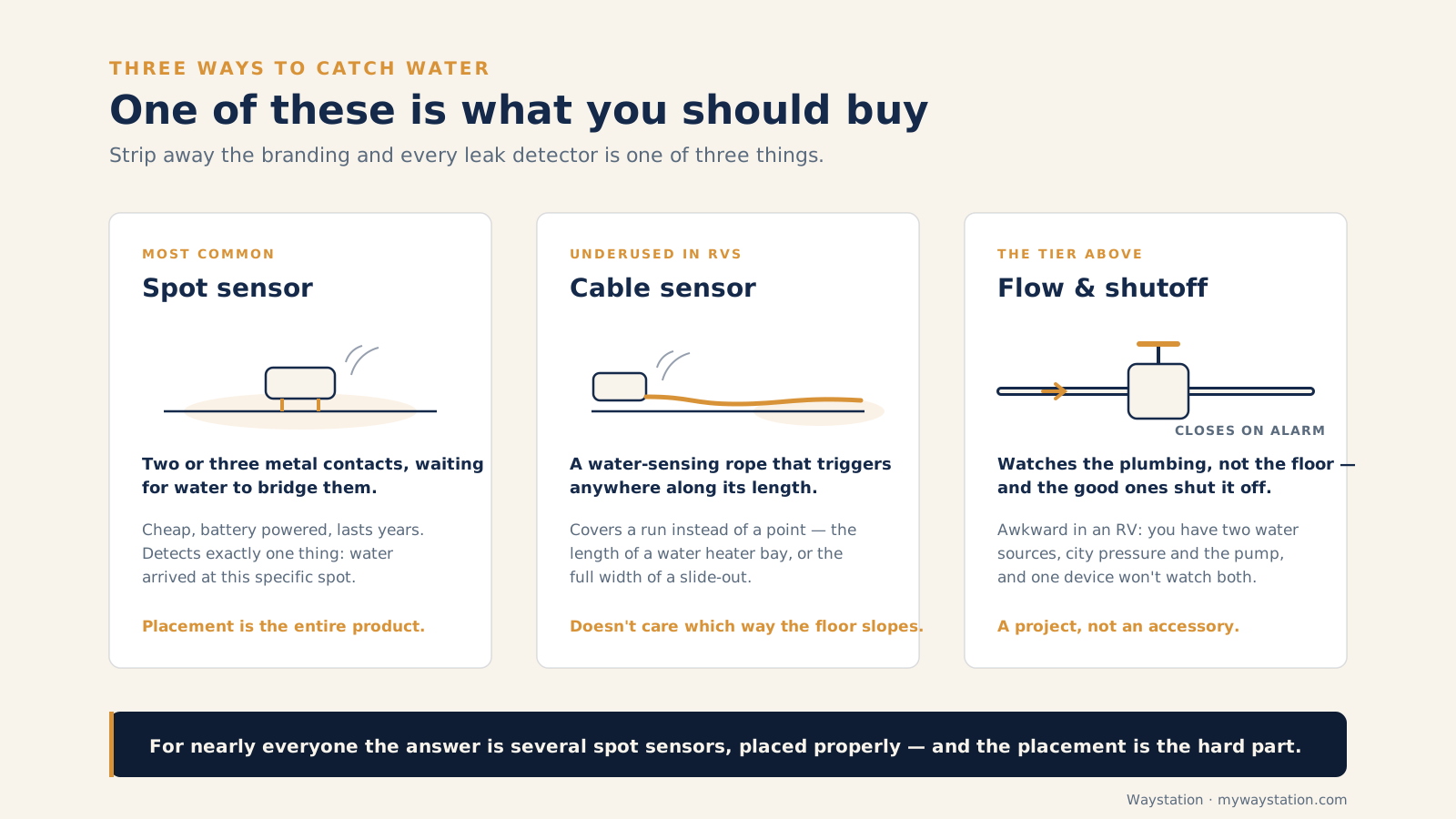
Spot sensors are what most RVers should buy; cable sensors cover a run; flow systems watch the plumbing.
Quick comparison
Prices are all-in, hub included — four of these five are inert without one.
| How it links | Onboard alarm | Freeze alert | All-in entry price | What that buys | |
|---|---|---|---|---|---|
| YoLink Water Leak Sensor 4 | LoRa, up to ¼ mile open air | 105 dB | Yes (23–59°F) | $89.99 (list $109.99) | Hub + 4 sensors |
| GoveeLife Leak Detector 1s | Sub-1 GHz, 550 m claimed | 105 dB | No | From $43.99 (list $54.99) | Gateway + sensors |
| Aqara Water Leak Sensor | Zigbee | Yes | No | $48.98, or $18.99 alone | Sensor + E1 hub ($29.99) — hub free if you already run Zigbee |
| Zircon Leak Alert | None — it just screams | 90 dB | No | $14.99 | The whole thing |
| RV Whisper WTR1 | Bluetooth to the hub | Via the system | No | Not published | Sensor + RVM3 station |
1. YoLink Water Leak Sensor 4 — best overall for RVs
It wins on a radio choice: LoRa, rated up to a quarter mile in open air — a rear-bathroom sensor reaches the hub without fighting the aluminum framing that defeats WiFi. Add 105 dB, IP66, 5+ years on two AAAs, and built-in low-temperature sensing (23–59°F): one device for "water on the floor" and "about to freeze."
Buy the kit, not the sensor. The $19.99 single is out of stock as of this writing — and a bare sensor needs a hub anyway. The entry is the Starter Kit: hub plus four Sensor 4s, $89.99. The clincher is Control-D2D: pair a sensor straight to a siren or shutoff valve; the link fires without internet, app, or cloud.
The honest catch: YoLink has no cellular hub. Both hubs — kit and X3 ($59.99) — want 2.4 GHz WiFi or Ethernet. In a storage lot it screams and can close a paired valve, but it can't text you — see our connectivity guide. With power, the X3 adds an 8-hour backup battery, a switch-to-battery alert — a shore-power loss alert in itself — and an offline alert after five minutes.
Get it if you want leak and freeze coverage with local action when the network is down. Skip it if you won't add a hub or want built-in cellular.
2. GoveeLife Water Leak Detector 1s — best budget smart sensor
Same architecture, cheaper: long-range Sub-1 GHz sensors (550 m claimed) and a small WiFi gateway. 105 dB with four volume levels, IP67, a claimed 5-year battery, and gateway bundles from $43.99 (list $54.99) — cheap enough to buy enough sensors — the whole game.
The limits: the gateway is 2.4 GHz WiFi-only, no D2D fallback, and no freeze alert — half the reason to cover a stored rig's plumbing bay.
Get it if you want the most sensors per dollar and have WiFi you control. Skip it if you need freeze alerting, or the RV winters offline.
3. Aqara Water Leak Sensor — best for Home Assistant and DIY builds
At $18.99 — IP67, built-in alarm, about two years on a CR2032 — it's a fine sensor. The pick-maker is Zigbee: the one entry where the hub can cost nothing.
Run Home Assistant in the rig? Then you already own a Zigbee coordinator and each sensor really is $18.99 total. Aqara requires its own hub — the $29.99 Hub E1 from cold — but pairing any Zigbee coordinator via Zigbee2MQTT is community-documented (not vendor-supported). Then a leak becomes a trigger: kill the pump, fire the siren, send the push.
The caveat: a coin-cell puck built for bathroom floors — a quarter of YoLink's battery claim, and RV vibration is hard on everything.
Get it if you run Home Assistant or are building toward it. Skip it if you want to open a box and be done.
4. Zircon Leak Alert — best if you're actually in the rig
No app, no hub, no account: $14.99, a 9V battery, and 90 dB when the contacts get wet.
The smart-sensor world has a blind spot: if you're sleeping thirty feet away, a screamer on the floor is a complete solution. Full-timers are aboard most of the hours the plumbing is pressurized; it stops working where the others start — the rig alone in storage.
Get it if you're aboard whenever the water's on, or as cheap insurance under a connected system. Skip it if the RV sits unattended — for most rigs, most of the year.
5. RV Whisper WTR1 — best if you already own the system
A wireless puck — water bridges its three metal legs — talking Bluetooth to the RVM3 Monitor Station, ten per station. The draw is context: RV Whisper watches the whole RV, so a leak lands in the same alert stream as temperature, doors, battery, tanks.
The catches, per our full system comparison: the RVM3 is WiFi-only, and RV Whisper publishes no price for sensor or station. Easy add-on; price the whole system before buying in.
Get it if you already run an RV Whisper station. Skip it if you're starting from zero — start with the YoLink.
What a water leak detector actually is
All five picks are spot sensors: metal contacts just off the floor, waiting for water to bridge them. They detect one thing — water reached this spot — so placement is the entire product. An RV leak sensor eighteen inches from where water pools is a decoration.
Cable sensors cover a line instead of a point; flow systems watch the plumbing and can close a valve, but an RV's two water sources — city and pump — mean one device can't watch both.
Why an RV needs this more than your house does
Your RV is a building that rides through a small earthquake every time you tow it.
Everything vibrates loose — PEX fittings, compression nuts, P-traps — under road vibration no house plumbing sees.
The sealants are on a clock. Jayco's owner's manual says to inspect every sealant "a minimum of every six months," reseal at least annually — and warns that damage from an uncorrected leak may not be warrantable.
There's no floor drain. A house leak lands on a slab; an RV leak soaks into a laminated floor that is structural.
And nobody's home — the typical RV sits unoccupied most of the year.
What actually leaks
From forum post-mortems, roughly in order:
- Water heater connections and winterizing bypass valves
- City water inlet and backflow preventer — the highest-pressure point
- Toilet supply valve and flange seal
- Shower pan and surround seams
- Sink drains and P-traps
- Fresh tank overflow and pump fittings
- Roof penetrations and slide seals
- Washer hookups, where fitted
Most are places you never look — exactly why those leaks run for weeks.
What a slow leak actually costs you
The damage isn't the water. It's the time.
The structure absorbs it. Water gets between the laminated layers and they separate — the sidewall bubbling owners call delamination. A $4 fitting becomes structural repair, and it follows the rig to resale.
Mold follows fast — see our humidity and mold guide — but a leak supplies water far faster than humid air.
Coverage often says no. Warranties cover defects, not skipped maintenance. Insurance covers sudden, accidental RV water damage — not a fitting that wept for two months. Both draw the line at how long it went unnoticed, the one variable a $20 sensor changes.
Where to put them
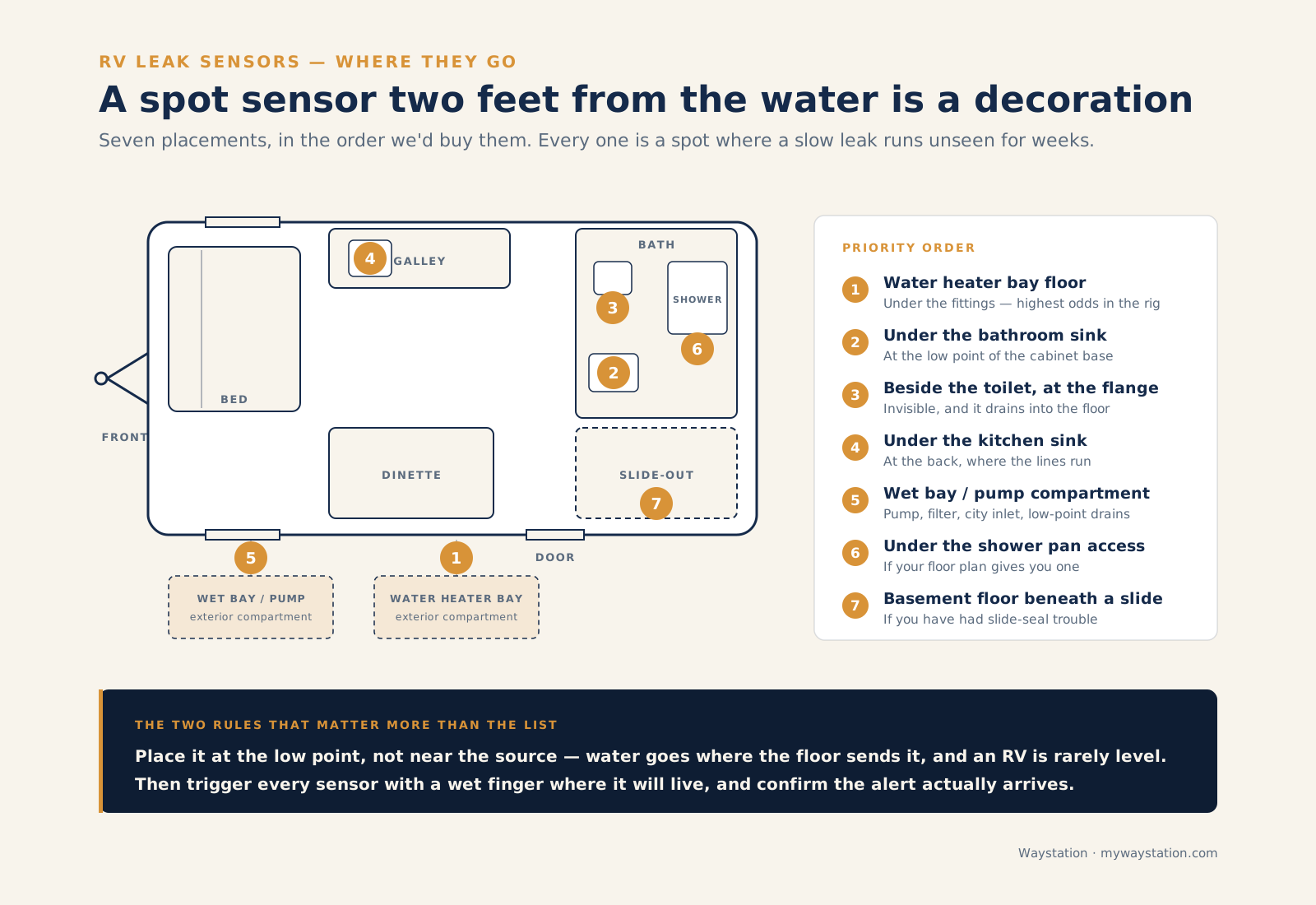
Generic advice says "near your water heater." The real RV list, in order:
- The water heater bay floor
- Under the bathroom sink, at the cabinet's low point
- Beside the toilet, at the flange
- Under the kitchen sink
- The wet bay / pump compartment
- Under the shower pan access
- Beneath a slide, if you've had seal trouble
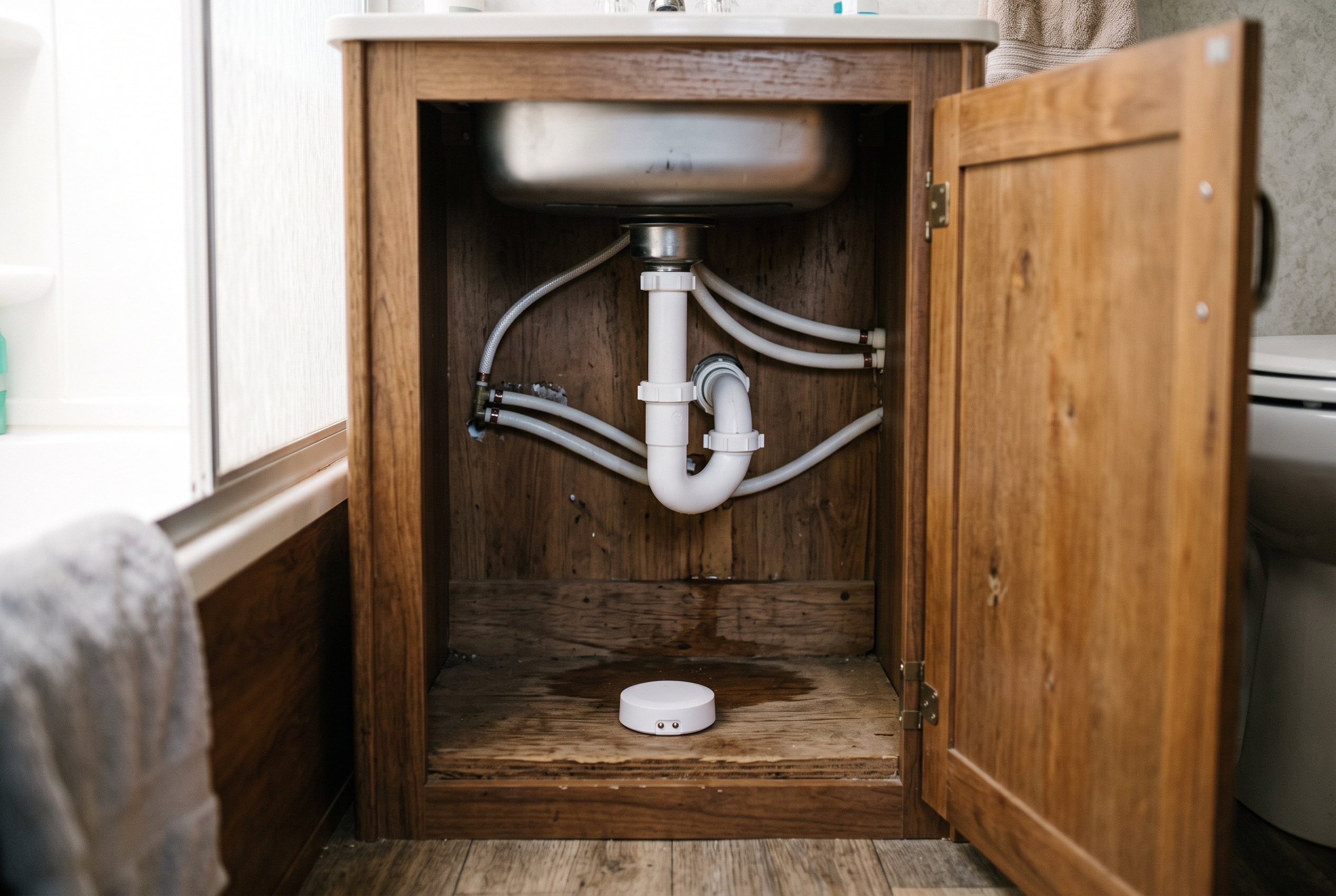
The sensor goes on the cabinet base at the low point, not up beside the fitting.
Two rules beat the list. Put it at the low point, not near the source — an RV is rarely level; water pools wherever a spilled cup would. And test the radio where the sensor will live — a metal wet bay far from the hub is the hardest link. Trigger it with a wet finger and confirm the alert arrives.
The part that decides whether any of this works
The hub doesn't supply the internet. At home, easy; at a seasonal site, park WiFi; a water sensor in RV storage usually has no internet — it records an event nobody hears about. So layer: a screamer that always works, plus connected sensors for the months away. More in our storage monitoring guide.
FAQ
Will a water leak sensor work in an RV in storage with no WiFi? The alarm sounds; the notification won't reach you — no pick here has a cellular radio. Bring a hotspot with reliable power, or pair sensors to a siren or shutoff valve.
How many leak sensors does an RV need? Three is the floor: water heater bay, bathroom, kitchen; five or six covers a typical trailer. Buy a kit — the one bay you skip is the same as no sensors.
Why does a $20 sensor end up costing $90? The sensor is half a product: four of five picks talk a low-power radio — LoRa, Sub-1 GHz, Zigbee — that your phone can't hear, so a hub translates. Only the Zircon skips the radio and screams.
Do leak sensors detect freezing pipes too? Some: the YoLink Sensor 4 senses low temperature, adjustable 23–59°F. The Govee and Aqara picks detect water only.
Are RV water leaks covered by insurance? Sudden, accidental damage generally is; gradual leaks and deferred maintenance aren't. Warranties draw a similar line — Jayco's manual warns an uncorrected leak may leave damage outside coverage.
Can I use regular home leak sensors in an RV? Yes — four of five picks are ordinary smart-home products. What doesn't transfer: placement, vibration tolerance, and the assumption of WiFi.
Bottom line
Buying one thing? The YoLink starter kit — hub plus four Sensor 4s, $89.99: long-range radio, freeze alerting, D2D action when the network is gone. Add the X3 Hub where there's power. Home Assistant owners: Aqara, $18.99. Put a $15 Zircon under the bathroom sink regardless — it survives power, internet, and subscription outages.
Then do the two things nobody does: place sensors where water actually pools, and wet-finger test each one. The sensors are cheap and reliable; the part that fails is getting the news off the rig.
Stay in the loop
Occasional updates from the road and the workbench — what we're learning, what we're building. No spam, easy out.